




Young,
James Edward ()/ Baigell, Matthew()//Golan, Romy () -The art of memory
: Holocaust memorials in history (1994) [Prestel; New York; p.194; 30
cm ; Publication on the occasion of the exhibition "The art of memory:
Holocaust memorials in history ", held at The Jewish Museum, New
York, March 13-July 31, 1994]
The
Western Wall, a surviving fragment of the Second Temple in Jerusalem destroyed
in 70 C. E., evokes the memory of communal catastrophe and mourning. Photographed
by La Maison Bonfils, i867-ca. 1907, albumen print. [p.22]
One
of the many unofficially marked mass grave sites for| Jews murdered in
the former Soviet Union. Here in Kaunas, Lithuania. [p.27]
A
homemade, wooden Scar of David nailed to a tree, ioo meters from a mass
grave in the Rumbuli Forest, Latvia. [p.28]
Site
of the mass grave of 8,000 Holocaust victims in Telsiai Lithuania. In
several photos, family members look into an empty clearing: nothing is
there. Yet it is written on the back of one of these photographs that
this is the site where 8,000 Jews were murdered. These photographs of
now-absent memorials begin to function over time as memorials themselves.
[p.28]
Karin
Daan created the Homomonument for homosexual victims of Nazism, dedicated
in Amsterdam in 1987. The monument has also come to serve as a memorial
site for those who have died of AIDS. [p.30]
The
commemoration triangle (right) bears an inscribed text from a poem by
Jacob Israel de Haan: "NAARVRIENDSCHAP ZULK EEN MATELOOS VERLANGEN"
(Such a boundless longing for friendship). [p.30]
The
German artist Norbert Radermacher used slide projections) to focus attention
on a site of Nazi violence. Pedestrians who walk by trip a light-beam
trigger, which in turn Hicks on a high-intensity slide projection of a
written text relating the historical details of the site's now invisible
past. ("From 1944-1945 there was here an satellitel department of
the Concentration-camp Sachsenhausen" tj.) [p.35]
The
slide projections here refer to a forced labor camp, which later became
one of Sachsenhausen's satellite camps. Conceived in 1989 and to be installed
in the Neukolln district in Berlin, 1994. [p.35]
Nathan
Rapoport: Warsaw Ghetto Monument, 1948. Warsaw, Poland. [plate 3]
Franciszek
Duszenko and Adam Haupt: Treblinka Memorial, 1964. Treblinka, Poland.
[plate 4]
Lipa
Yahalom and Dan Zur: Valley of the Communities, 1983-93. Yad Vashem, Jerusalem,
Israel. with many names of communities like Kiev and Babi Yar [plate 7]
Shimon
Attie Almstadtstrasse 43, Slide Projection of Former. Hebrew Bookstore,
Berlin, Germany 1991/1931 [plate 19]
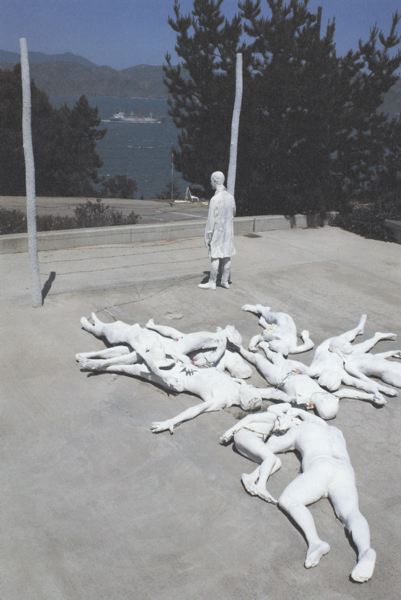
George
Segal: The Holocaust, 1984. Lincoln Park, San Francisco. [plate 29]
View
of the inscription added to the poster wall as a commemoration of Kristallnacht
after the monument was firebombed in 1988. "On the night of November
9, 1938, all synagogues in Austria were looted, destroyed, and set on
fire. And during the night of November z, 1988, this memorial was destroyed
by a firebomb." [p.81]
The
Haacke installation, and the statue of the Virgin Mary it covered, suffered
major damage from a firebombing one week before the exhibition closed.
[p.81]
A
visitor ventures behind the barbed wire fence in Lincoln Park, San Francisco.
[p.86]
A
stone memorial inscribed in Polish, Hebrew, and Yiddish marks the ruins
of Mordechai Anielewicz's Ghetto bunker at Mila 18, Warsaw. [p.125]
tPublic
pressure led to the construction of the memorial at Babi Yar, a ravine
near Kiev, where the Germans murdered 34.000 Jews in 1941. The inscription
to the "Citizens of Kiev" bears no mention of the Jews. [p.143]
A
family at the site of a mass grave in Zidikai in Lithuania where 3,000
were killed. Since such sites remained unofficial in the former USSR and
memorials were often destroyed, snapshots from family albums serve as
their only documentation. [p.145]
Montreal
synagogue group photographing the entrance of Birkenau, the extermination
center at Auschwitz. [p.174]
The
parking lot in front of the visitors' center in Auschwitz 1989. The building
was erected as a "reception hall" for the camp in 1941. From
Reinhard Marz's series of some 100 photographs entitled "The Invisible
Camps," 1987-92. [p.180]
A
United Synagogue Youth Mission reciting prayers and• poems at Treblinka.
[p.181]