
"The whole world is a school for mankind for all men, about all
things, in all ways"(1)
In 1658 the Orbis Sensualium Pictus was published in Nuremberg. This illustrated
Latin text book, provided with parallel translations in other languages,
was at the same time a summation of man's knowledge and experience in the
mid 17th century. Within 150 pictures, the entire world is shown in tangible
and intangible phenomena. Through the use of numbers, different parts of
the illustrations are linked to a text, phrased in short sentences. These
sentences explore the different parts of the 'tableau' and clarify the natural
cohesion of its parts. This publication is part of an earlier educational
method developed by Comenius (2). The
book was quickly a resounding success and has been published, over two centuries,
in numerous editions, always using two, sometimes three languages as its
basis. The languages of the different translations in chronological order
of publication are: German, French, Italian, Polish, Hungarian, Danish,
Dutch, Swedish, Czech, Hebrew, Russian, Slovenian, Spanish and Lithuanian
(3). The first illustrations were produced
by using woodcuts, later copper and steel engravings.
Comenius considered education as an ongoing process that was to be continued
throughout one's lifetime - from childhood until old age. For him the world
itself was a grand school of learning. His philosophy forms a bridge between
antique humanism and enlightenment. His wish was to use his universal philosophy
(pansophy) to reform the entire human world: If the scene of the world is
to be changed, it is essential that all man's education should be changed,
and that from the very foundations..
A few of Comenius' basic educational principles are: From nearby to distant.
From well known to unknown. From simple to complex. From tangible and concrete
to abstract and generalised. Not forced, but playful learning .
In language education: From mother tongue to foreign language. From things
to ideas and words. (We learn things and notions before words). Understanding
the cohesive unity of things on different
levels and thus the world as a whole. Things are the basis for language,
and thus language is the way in which to encompass the world. Children can
easily memorise scriptual and secular stories from pictures. (see Appendix
I)
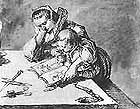
Woman instructing a child with the help of a picture book. Drawing by the
Dutch engraver Jacques de Gheyn (1565-1629), a contemporary of Comenius.
Svetlana Alpers uses this picture in her book "The Art of Describing,
Dutch Art in the Seventeenth Century" (1983) with the following comment:
"The idea that pictures are a form of language and hence a way to acquire
knowledge of the world seems to be the assumption of the drawing by De Gheyn
(...). The woman and the child who lean over a book of pictures could be
promoting Comenius's Orbis Pictus."
In the world of Comenius, all reality is nothing more than a constantly
varying realisation of a single divine, overall plan. Such a world can be
thus understood through a uniform and methodical education. Not a fragmentary,
but an omniscient knowledge.
Comenius was one of the first to use, on the basis of a didactic system,
images in school textbooks. The amount of 150 illustrations of the Orbis
Pictus was considered to be exceptionally large for the time. It took two
years to create and produce the woodcuts. The idea, on itself, of using
pictures as an educational aid was not new. In the middle ages before book
printing began, murals and paintings in churches were considered as books
for the layman. In the beginning of the 16th century, the German schoolmaster
Johan Buchstab speaks of 'painted letters', that helped his illiterate mother
in studying the holy word. With the arrival of block print, one sees the
mass distribution of 'poor man's bibles', calenders and allegoric prints.
In the 16th century, the growth of new empirical sciences, the development
of book printing, and the need for better distribution of knowledge, led
to the need of supplementing the text with images. In time the character
of these illustrations changes from the allegorical to the more realistic.
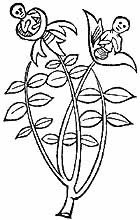
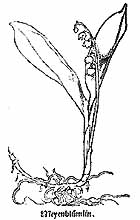
Books dealing with architecture, mining, healing arts, birds, fish, plants
and animals began to appear. Comenius could base his ideas on predecessors
such as Andreas Vesalius (1543: anatomy), Gregorius Agricola (1556: mining),
Jacob Besson (1578: instruments and machines) or Conrad Gessner (1586: animals).
Other popular books of the time dealing with estate and trade by such authors
as Jost Amman and Hans Sachs (1568), also were sources of inspiration for
the Orbis Pictus (4). Further inspiration
for Comenius can be found in the utopian writings of Tommaso Campanella,
in his La Citta del Sole/The city of the sun (1602), and Johan Valentin
Andrea's Reipublicae Christianopolitanae Descriptio (1619) (5).
These books contain descriptions of cities where one would find paintings
which relate the world and heavens as well as all of the world's knowledge.
In Campanella's The City of the Sun one finds a circular temple of the sun
adorned with images of the stars, surrounded, in concentric circles, by
seven walls - six of which are painted with representations of the whole
of creation and of man and his undertakings. The children of the city are
instructed by the sun-priests, who teach them by leading them along the
walls of the city to see these murals: "On the outer wall (of the first
circuit) there is a map of the entire world with charts for each country
setting forth their rites, customs and laws; and the alphabet of each is
inscribed above the native one." There follows a detailed description
of each instructive wall. This way of teaching is summarized by Campanella:
"without effort, merely while playing, their children come to know
all the sciences pictorially before they are ten years old" (6).
Further influences can be found in Robert Fludd's encyclopedic work History
of the Macrocosm and Microcosm (1617 - 1626) with it's imaginative description
of the cosmic harmony, and in Francis Bacon's utopian story of New Atlantis
(1627) (7).
Innovative in the Orbis Pictus is the didactic method whereby word and image
are presented in a contextual way, as Comenius explains: "Now there
is nothing in the understanding which was not before in the sense. (8)
It is a little book, as you see, of no great bulk, yet a brief of the whole
world, and a whole language: full of Pictures, Nomenclatures, and Descriptions
of things."(8) Words are presented as parts of still lifes and landscapes
(tableaus). Each tableau has a title (nomenclatura) and the words on the
accompagning page are corresponding with numbers in the tableau. Each word
is set in a short phrase. It is a system whereby singular things are shown
in their 'natural' context. Most of the tableaus are concrete, some schematic
and only a few allegoric (see Appendix II for a list). This tableau system
with its landscapes and still lifes gives the opportunity to order and unify
in one place, according to classes and groups, that what in reality is seperated
in time and space. It shows the singular in relation to the whole. This
approach is distinctive from the 'lexica system' whereby the, arbitrary,
alphabetical order is the primary ordering principle and an incoherent mass
of singular pieces makes it difficult to get a picture of the world as a
whole.(9)
The learning book Orbis Pictus with its 150 tableaus and almost 2000 numbered
items, describing the whole world and its phenomena in a consize way, had
many successors (10). The same basic
concept can be found in picture books published different times and places,
some with the same wide scope, others with a more limited subject. There
are also predecessors as mentioned before that laid the basis for the Orbis
Pictus (11). A selection of these pictorial
books form the basis for a part of the project Orbis Pictus Revised (interactive
installation with touch screen: looking and pointing).
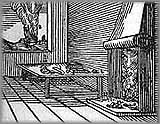
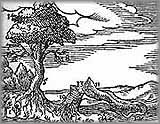
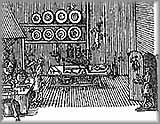
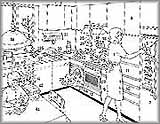
Some of the visual inspiration sources and predecessors are:
1543 Andreas Vesalius: Anatomia 1561 Georgius Agricola: De re metallica
1568 Jost Amman and Hans Sachs: Stndenbuch 1582 Jacob Besson: Theatrum instrumentorum
et machinarum 1587 Conrad Gesner: Allgemeines Thier Buch 1657 Johannes Amos
Comenius: Vestibuli linguarum auctarium
1658 : Johannes Amos Comenius: Orbis Sensualium Pictus
Some of the successors are:
1713 Johan Georg Seybold: Teutsch-Lateinisches Woerter-Buechlein; 1720 Johannes
Amos Comenius: Orbis Sensualium Pictus (with renewed illustrations); 1768
J.B. Basedow/Daniel Chodowiecki: Elementarwerk; 1796 Johann Georg Lederer:
Der kleine Lateiner ...; 1835 J.E. Gailer: Neuer Orbis Pictus fuer die Jugend
(renewed edition); 1852 Karl Amerling: Orbis Pictus (renewed edition); 1883
Jan Karl!k: Orbis Sensualium Pictus (renewed edition); 1937 F. Pokorny/C.
Palocaj: Neue Orbis Pictus/Novy Orbis Pictus (renewed edition); 1978 E.C.
Parnwell/Attar Singh: Oxford picture dictionary; 1979 Dieter Solf/John Pheby:
Oxford-Duden pictorial German-English dictionary.
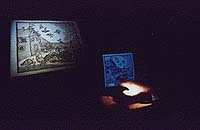
How to use & navigate the installation:
Looking and pointing: A touch screen (mounted in a console). A large monitor
stands at some distance from it. A sound reproduction system (acoustical
dome) is suspended overhead. On both screens icons are shown, which are
related to the pictorial material of the Orbis Pictus, some of its predecessors
and successors form the 16th. to the 20th. century. Thus, the visitor can
make choices by touching certain areas of the small screen. The visitor
is guided through this system at 5 levels, from abstract to concrete: cosmograms,
divisions of knowledge, pictograms, tableaus and details of tableaus (singular
beings, things, phenomena) (see Appendix IV). Choices are made by touching
the screen. Except for the numbers in the tableaus there is no text on the
screen. Touching parts of the screen will trigger spoken language (words
or short phrases) in the language one chooses (Latin, Czech, German, English
or Dutch). Navigation through the system is aided by three icon based menu
bars at the borders of the touch-screen: language, level, time. The imagery
used from the 16th. to the 20th. century is all in black and white (in some
cases with shades of grey). A '21th. century' image level with a very brief
moving image sequence in color ('video words') is presented when one chooses
to move through time beyond the 20th. century. If certain functions or items
have changed in the course of history, this will be visualized by a graphical
metamorphosis from the old into the new, as for instance the metamorphosis
of a horse into a car (see Appendix V).
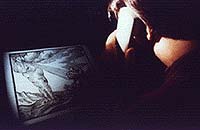
Speaking and listening: On a console lays a telephone horn (without the
dialling part). In front of it stands a large monitor. Sound is reproduced
from an acoustical dome suspended overhead. When the visitor takes up the
telephone and speaks (e.g. 'hello') the introductory tableau picture of
the Orbis Pictus with teacher and pupil appears on the screen of the monitor.
The teacher presents the available languages (Czech, Dutch, English, German,
Latin). The visitor can choose two languages (her own and a 'foreign' language).
Then a sequence starts, inspired by the 'playful alphabet' at the beginning
of the Orbis Pictus, consisting of pictures relating to onomatopoeic (imitative)
sounds (see Appendix VI) The sequence starts with 26 images symbolizing
different sounds related to one of the 26 letters of the alphabet. The visitor
is invited to produce these sounds (or letters) by speaking into the telephone
horn. A computerized voice recognizing system is attached to this. Each
time a sound or letter is recognized one of the relating 26 pictures on
the screen disappears and is replaced by the corresponding letter of the
alphabet. This continues till all letters have been recognized. When all
the 26 pictures thus have been altered, the screen changes, and only those
letters appear which correspond with the initial letters of the titles of
the 150 tableaus of the Orbis Pictus (in the chosen 'own' language). The
visitor is asked to choose one of these letters. As a result picture details
of the corresponding tableaus (with the selected initial letter) are shown
on the screen. Each of the pictures has a number. Choosing a number brings
the visitor to the respective tableau with its numbered items. One can then
ask for the words belonging to the numbered items. The words will be spoken
by the system in the two chosen languages. By clearly speaking a singular
letter (if there are tableau titles beginning with that letter) one can
go back to the stage where a choice can be made again from series of picture
elements from tableaus with that particular letter are offered.
Touching and feeling: The scene is formed by a circular table with a cut-away
section that allows one person to stand in it, with a large monitor in front
and an acoustical dome for sound reproduction overhead. On the table a collection
of a 150 different toys, playthings and other arty/ crafty objects is spread
out. All these objects, in one way or another, represent real things. They
are all doubles or copies of the same objects that form also a part of the
assemblages. All these objects are hand size and their difference in material
outlook and colour is covered by gray paint. Each of these objects is related
to a tableau picture of the Orbis Pictus. They can be taken at will and
moved in the different sensing areas above the table (see Appendix VII).
First a relating detail of one of the 150 tableaus of the Orbis Pictus is
shown and the word for the object is spoken by the system. Next the picture
zooms out to the whole tableau and the word is repeated, now as part of
the short contextual sentences which accompagny each Orbis Pictus tableau.
There are 5 different sensing areas which are marked by concentrated bundles
of light, each of them belonging to one of the languages of the system (Czech,
Dutch, English, German, Latin). Choosing a different sensing area results
in a change of language. This part of the installation can also be used
by blind people.