|
The renowned British historian,
Simon Schama, opened his epic portrait of the golden age of Dutch
culture with the words: "It is the peculiar genius of the
Dutch to seem, at the same time, familiar and incomprehensible".
In the days after the killing of Pim Fortuyn, it could be said
that the resonance of this singular judgment came to be shared
by the people of the Netherlands themselves.
In the most painful and shocking of circumstances,
and under the intense, unexpected gaze of the world's media, they
became collaborators in a new enterprise: making sense of a still
familiar but suddenly incomprehensible social landscape.
For
a country, as for an individual, putting oneself under honest
scrutiny can be a difficult as well as a necessary task. It is
also one that, inevitably, generates insights and understandings
that are different to those produced by outside scrutiny. Without
these, no larger truth is possible.
This,
then, is a first attempt to communicate to a mainly non-Dutch
audience, some elements of politics and society in the Netherlands
that form the background to the crisis the Dutch people are now
living through. It is merely an overture, an invitation to the
familiar strangeness of this northern European country of sixteen
million inhabitants.
[introduction by David Hayes of Opendemocracy.org;
2002/05]

Spontaneous memorial at the steps of the
National Monument for World War II at Dam Square, Amsterdam; handwritten
comment on newspaper photographs "our president" the visible fragment
of the postcard reads: "Ascension Day 9th May 200. The monarchistic-social
dictatorship is now () in Argentinia thousands of people () a
Royal has () your opinion.." (so references to the Dutch royal
house and the recent engagement of the Dutch crownprince with
the daughter of an ex-member of the Argentinian dictatorship under
general Videla.
[photograph by author]
Puncturing
harmony: politics in the Dutch lands
Every
few decades Dutch party politics seem to need a shake-up and a
wake-up to re-establish the power balance of the social forces
in the country, be they good or bad. Just before and after the
Second World War, the NSB (Dutch Fascist Party) and the Communist
Party had brief periods of sharply rising support. In the early
1960s, three new parties successively emerged: the Boerenpartij
(a protest party of farmers fighting the rationalisation of agricultural
production), the Amsterdam-based Provos (an anarchist mockery
of the parliamentary system as such), and D66 (Democrats 1966,
a party advocating reform of the Dutch parliamentary system, including
referenda).
Some
of these parties (NSB, Boerenpartij) have vanished completely
from the political scene. Others fused some of their ideas and
membership into what could be called 'regrouping parties', new
entities made up of bits and pieces of minor older parties, like
Groen Links (Green Left, a funny fusion of former communists,
Maoists, pacifists and radical Christians).
In
the 1990s, a stable governmental alliance between Social Democrats
(PvdA), free market Liberals (VVD), and the reformist D66 ran
the country, consigning the main Christian Democratic Party (CDA)
to a minor role on the opposition benches. This troika is labelled
'purple' in Dutch - the mix of the three party colours: red, blue
and green.
This
decade of 'purple' politics in the Netherlands was in itself a
break with a much longer tradition of power sharing, in many cabinets,
of the PvdA and the CDA, with one or two smaller parties added
to make up a governmental majority.
The
end of purple stability
The
shake-up to this recent period of 'purple rule' had its first
expression in local elections, with many locally initiated parties
- often called Leefbaar-(Liveable) followed by the name of a village
or town. The issues raised by these parties varied depending on
the particular area. But in general they focused on 'quality of
life' issues: recurring elements were environmental, housing,
and traffic problems, and sometimes also questions about 'foreigners',
be it the influx of refugees or lamentations about the lack of
adaptation of other nations, religions and cultures to Dutch society.
After
the success of such Leefbaar parties in some bigger cities in
the mid-1990s, an initiative was made to try to bundle this locally
dispersed force into a national Leefbaar Nederland party.
A
short-lived reign
The
bundling of loose parts implies the use of a binding element,
and little coherence could be found in the diverse assembly of
many of those local parties. Also, the initiators of the new Leefbaar
Nederland party did not manage to formulate a coherent party philosophy
or programme. So, as in older days when a new nation was looking
for a king to help force a diverse population into a unified state,
they started looking for a leader.
Soon
a king was found and crowned in the person of a commentator on
Dutch social and economic affairs, a former professor of sociology
at the University of Groningen, a 'coming out' homosexual, and
a provocative public debater: Pim Fortuyn.
But
his reign over the new national party, which he was supposed to
lead into the national elections on 15 May 2002, could be counted
in days. Fortuyn's strong statements on controversial issues,
like the lack of integration of Muslims in Dutch society and the
halt to accepting more refugees, led to a polarisation of public
opinion. The disapproval extended also within the 'eclectic' structure
of Leefbaar Nederland itself, with its base in many local and
differing single- (or dual-) issue component parties.
Though
some of these local party voters could associate themselves with
Fortuyn's views on 'foreigners' and 'integration', it certainly
was not the highest common factor among them. A congress of Leefbaar
Nederland even voted against such ideas and policies.
Fear
of foreigners
Why,
then, was Pim Fortuyn asked at all to become the leader and public
'face' of this party? The answer is to be found in the Dutch mass
media - television, radio and the written press.
Fortuyn's
own position as a former columnist for a conservative weekly,
Elsevier, his close relations with some Dutch television
figures (especially on the commercial RTL channels), and most
of all the irresistible attraction of his flamboyant figure that
was making the rather dull Dutch political debate tasty again,
meant that more and more journalists were eager to interview him,
host his presence, have him join their debating table.
Selecting
Fortuyn as party leader of Leefbaar Nederland meant a secure ticket
to a lot of media exposure; it was the fastest and cheapest way
to reach a mass audience. He had the charisma that the already
bickering founders of this new party certainly had not. The leadership
of the Leefbaar Nederland party was aware of Fortuyn's 'soloist'
tendencies, and the possible incompatibility of his views with
part of its membership. At the same time they gambled, as they
knew that some of Fortuyn's views - giving expression to widespread
'xenophobic' sentiments in Dutch society - could attract growing
support (it should be noted that the word 'xenophobic' means 'fear'
of foreigners and certainly not 'hatred' of foreigners).
Free
speech champion
It
was, then, a double-dealing policy - trying to reach out to a
wide spectrum of the electorate, both progressive and conservative
- with Fortuyn as the Janus-faced priest. Fortuyn was to be allowed
to express his radical views on religion and the position of foreigners,
but not too explicitly, as that would alienate the more tolerant
potential voters.
The
problem was that Pim Fortuyn behaved like an absolute, not a constitutional
monarch. He continued to express his ideas freely, and to make
provocative statements. An article in the national daily De
Volkskrant in early 2002 ended his leadership of the Leefbaar
Nederland party. The article not only inveighed against the 'backwardness'
of Muslim culture, it also announced that, once in power, Fortuyn
would close Dutch borders to all refugees.
Moreover,
Fortuyn stated that the amendment to the first article of the
Dutch fundamental law in 1983, forbidding discrimination ("on
the grounds of religion, belief, political opinion, race, or sex
or on any other grounds"), should be scrapped, as it contradicted
the older and more fundamental constitutional article protecting
"freedom of expression" (article 7: "No one shall
require prior permission to publish thoughts or opinions through
the press, without prejudice to the responsibility of every person
under the law").
Fortuyn
paradoxically also made reference, in this controversial interview,
to the dangers of Muslim fundamentalists in the Netherlands wanting
to deny him free expression of his homosexuality. As Fortuyn refused
to recant his public statements, emphasising the need to be true
to his convictions, he was relieved of his office by those he
was supposed to lead. All this happened in the full glare of the
media, making Fortuyn into a champion of free speech, the 'only
one' in the nation who dared to speak his mind in public.
Landslide
victory
Ejected
from his throne at Leefbaar Nederland, Fortuyn had to found his
own kingdom. He turned defeat into a victory, waving from his
car at the press after he left the party meeting that had dismissed
him, shouting "Watch me, I will be the next prime minister
of this country!"
With
a small group of followers, Fortuyn created a new party and within
a few weeks rose spectacularly in the opinion polls. In his home
town, Rotterdam, he won a landslide victory in the local elections,
ending over half a century of social democrat rule (although other
places, like the city of Amsterdam, were hardly touched by the
'Fortuyn effect').
After
these municipal elections, some opinion polls suggested that Fortuyn's
new national party (Lijst Fortuyn) could become the second biggest
political force in the Netherlands. As the established political
parties saw their support shrink by the day, they were forced
to direct their fire against the high-profile leader of this brand
new party composed of otherwise obscure or indistinct figures.
Such
labels do not fit
Fortuyn
publicly employed a sharp, attacking rhetoric, and received the
same in return. The usual vocabulary, made up of names and notions
related to former dictators, was applied to him. Possible resemblances
to Hitler, Himmler and Mussolini were tested, and the old pair
of scissors to cut the social tissue in two halves could be found
in many people's hands - left and right, right and wrong - depending
on their position in the political field.
Fortuyn
was placed, from the beginning, on the 'right' side of this imaginary
cutting line, which has its roots in the English parliament and
the French assembly of two centuries and more ago: 'left' being
those who want movement and change, 'right' those who want to
fix and preserve. (One may ask if any society can be represented
at all by such a simplified dichotomy. At best the terms 'left'
and 'right' are mere markers on a scale on which opposing political
forces in a particular society and at a particular historical
moment can be compared.)
In
the context of Pim Fortuyn and the Netherlands, this simplified
dichotomy made little sense: after all, it was the 'right' which
wanted radical change and the 'left' which was defending what
they had attained. Yet demonic comparisons with actual political
and religious figures from other countries were used by both sides
in the election campaign. Fortuyn made a grotesque comparison
between Osama bin Laden and elderly lady Els Borst, the Democrat
party minister of health, because she had failed to shorten hospital
waiting lists (thus, in Fortuyn's vision, costing more human lives
than the terrorist attack on the World Trade Centre). Fortuyn
in return was labelled as the Dutch Le Pen, Haider and Berlusconi.
(He refuted all but the last comparison, perhaps because of a
shared fondness for smart suits.)
Only
in hindsight is this atmosphere of harsh rhetoric an element of
the tragedy of 6 May; that explains why literally everybody, for
or against Fortuyn, was so stunned by the violent act of one individual
who went (for reasons still unknown) out of his mind and killed.
Of course these glib labels do not really 'fit' and they do little
to explain the realities of Dutch politics or society. Rather,
this society needs to be explained, even by the Dutch to themselves,
first of all in its own terms.
Fragments
of Dutch identity
What
are the relevant characteristics of Dutch society that are part
of the 'deep background' of this extraordinary event in the country's
history, the murder of Pim Fortuyn? It is both too early and too
late to make more than a preliminary sketch, so here are just
a few pointers on the way:
It
is a country that has a tradition, over centuries, of covering
up social differences and problems: with elaborate charity distribution
systems within its own borders, yet a ruthless slave trade and
exploitation of people in distant colonies.
It
is a country that has been able successfully to link freedom of
trade with freedom of expression (in that order!).
It
is a country that has accepted religious refugees while at the
same time selling weapons or war services to the same nations
people were fleeing from.
It
is a country where opposing Christian churches, at last, learned
to compromise, be it partly for financial reasons, with no mass
killings of Catholics once the Protestants got into power (like
the alteration of power in Amsterdam in 1587: an "un-bloody
revolution").
It
is a country that has been a republic with a prince, and became
a kingdom with monarchical socialists.
It
is a country that was unable to protect its Jewish minority against
the Nazis.
It
is a country that fought a nasty colonial war half a century ago
in Indonesia and still has not come to terms with it (as reflected
in the war's official title, politionele acties or "police
actions").
It
is a country where homosexuals have been able to become emancipated
and where women's emancipation, in the economic sense, is lagging
behind.
It
is a country where the defeat of the proletariat by consumerism
was declared thirty-five years ago (by the Provo movement).
It
is a country where the art of repressive tolerance as a policy
instrument has been flowering for decades.
It
is a country where the membership and dense structure of volunteer
civil organisations in all fields of life far exceeds that in
any political organisation.
It
is a country that tries to accommodate thriving Surinam and Antillean
communities composed of people whose ancestors were once its slaves,
and has some difficulties in sharing its prosperity with the gastarbeiders
(literally "guest workers") who helped to create it.
It
is an over-developed country, offering great mobility to its own
citizens, but denying similar mobility to "refugee tourists"
from other parts of the world.
It
is a country where many opposed South African apartheid and the
horrors of the Balkan war, but very few would oppose the less
spectacular process, just around the corner, of economic cleansing,
the unsafe havens of Dutch welfare society, and local ghettoes
in the making.
These,
no doubt, are somewhat crude simplifications of the rich complexities
of Dutch society. My aim is to play a sort of overture, to create
an imaginative picture for non-Dutch people to get some understanding
of the drama of the moment that we, in the Netherlands, are living
through.
It
seems especially needed at this time. For while we Dutch tend
often to be well-informed about the fate of other nations, this
does not work the other way round, because of language problems
and the disinterest of many Dutch in communicating their own society
to outsiders.
This
is a very personal interpretation of recent events, with no claims
to objectivity. But I have tried to accord all players in this
drama, alive and dead, the dignity they deserve.
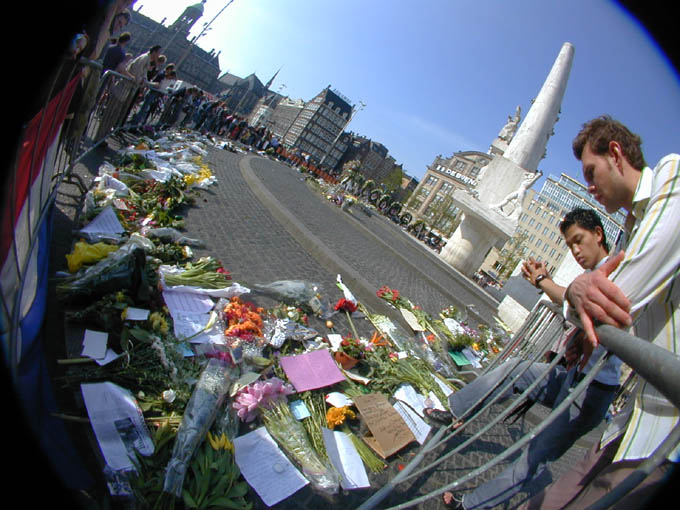
Dam Square Amsterdam, with National
Monument and Pim Fortuyn spontaneous monument on its steps, in
the background the former Amsterdam Town Hall, now Royal Palace.
[photograph by author]
|


